Affiliate disclosure: TwirlWeddings earns a commission on purchases made through links on this page, at no extra cost to you. This does not influence our recommendations.
A quality half-carat (0.50 ct) diamond ring generally costs between $700 and $4,500 in 2026. The final price depends heavily on origin: a lab-grown half-carat engagement ring typically runs $700–$2,000, while a natural half-carat ring costs $1,500–$5,000+. Cut quality, setting style, and where you buy all push that number up or down significantly.
Quick Answer: Half Carat Diamond Ring Price at a Glance
Ring Type
Typical Price Range
Half carat lab-grown diamond ring
$700–$2,000
Half carat natural diamond ring
$1,500–$5,000+
Half carat solitaire diamond ring
$900–$4,500+
Half carat engagement ring (average spend)
$1,200–$3,500
Half carat round brilliant diamond ring
Slight premium over other shapes
Designer brand half carat ring
$2,500–$8,000+
Quick VerdictBest value for most buyers: Lab-grown 0.50 ct, G–H color, VS2/SI1, Excellent cut Best long-term heirloom choice: Natural diamond, same quality grades Sweet spot budget: $1,200–$2,500 covers a genuinely beautiful ring at either origin
How Much Does a Half Carat Diamond Ring Cost?
The sticker price on a half carat diamond ring reflects two things: the diamond itself and the setting it sits in. Those are priced separately, then combined.
The diamond is almost always the bigger cost. A loose 0.50 ct natural round diamond in the G/VS2 range runs roughly $1,050–$1,500 through a reputable online retailer. A comparable lab-grown stone? Around $200–$500. That gap — which has widened dramatically since 2022 — explains most of the price difference between ring types.
Then there’s the setting. A simple 14K white gold solitaire adds $250–$450. Step up to platinum and you’re adding $600–$900. A halo setting or pavé band adds more. So a “half carat diamond ring” for $800 and one for $4,500 aren’t dramatically different stones — they’re often similar diamonds in very different settings, or natural versus lab-grown.
One common mistake buyers make is fixating on the carat weight while ignoring cut quality. A well-cut 0.50 ct diamond will look noticeably more brilliant than a poorly cut 0.60 ct stone, and typically costs less. Cut is the one quality factor you should never compromise on.
Half Carat Engagement Ring Price by Budget
Budget
What You Can Realistically Get
Under $1,000
Lab-grown solitaire in 14K gold; SI1 clarity, H–I color — perfectly presentable
$1,000–$2,000
High-quality lab-grown ring with Excellent cut, G–H color, VS2 clarity
$2,000–$3,500
Premium lab-grown or a solid natural diamond ring with good credentials
$3,500–$5,000
High-quality natural diamond with GIA certification
$5,000+
Designer brands (Tiffany, Cartier) or luxury custom settings
Budget buyers take note: a $1,200–$1,800 lab-grown ring from James Allen or Blue Nile will look just as beautiful on the hand as a $4,000 natural diamond ring. The only meaningful difference is origin — and that’s a personal call, not a quality one.
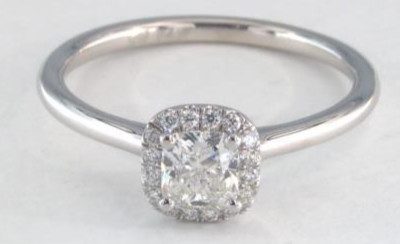
0.53 Carat J-VVS2 Excellent Cut Round Diamond 1.5mm Comfort Fit Engagement Ring
Half Carat Natural Diamond Ring Price
What a Natural 0.50 Carat Diamond Costs
Natural diamonds still command a premium, and prices have stabilized after the dip of 2022–2023.
Cut Quality
Loose Diamond Price (0.50 ct, G/VS2)
Good cut
$800–$1,200
Very Good cut
$1,000–$1,800
Excellent / Ideal cut
$1,200–$2,500
Note: The $3,500–$4,000+ figures you’ll see on some sites typically reflect designer retail markup (Tiffany, Cartier) rather than the underlying diamond value.
Why Natural Diamonds Cost More
Supply is finite and mining is expensive. That’s the honest answer. The romantic framing — “billions of years old, formed deep inside the earth” — is genuine, but it’s also why you’re paying a premium that doesn’t fully translate into resale value.
Natural diamonds do hold resale value better than lab-grown stones, retaining roughly 40–60% of retail value, though that figure varies by quality and market timing.
Who Should Choose a Natural Diamond?
Natural diamonds make sense if sentimental origin matters to you, if you’re buying as a long-term heirloom piece, or if the person receiving the ring specifically wants a mined stone. For buyers who prioritize visual quality per dollar, the calculation often points elsewhere.
Lab-grown diamond prices have fallen sharply — and they keep falling.
Cut Quality
Loose Diamond Price (0.50 ct, G/VS2)
Good cut
$150–$300
Very Good cut
$250–$450
Excellent / Ideal cut
$400–$700
A complete ring (stone plus 14K gold solitaire setting) starts around $600–$700 for lab-grown. A well-specified ring with Excellent cut and VS2 clarity typically lands at $900–$1,500 — roughly 60–70% less than an equivalent natural diamond ring.
The Honest Tradeoff on Resale Value
Here’s something some sellers won’t tell you: lab-grown diamonds retain almost no resale value. If you sold a lab-grown ring two years after buying it, you’d likely recover 5–15% of what you paid — if a jeweler will buy it back at all. Natural diamonds typically recover 40–60%.
That doesn’t make lab-grown a bad choice. Most engagement rings are never sold. But if resale value matters to you — or if you might want to upgrade later — this is worth factoring in.
Is a Lab-Grown Half Carat Diamond Worth It?
For most buyers, yes. The visual result is identical to a natural diamond. The savings are real. The only sacrifice is origin, long-term resale value, and the traditional narrative.
The recommendation for most readers: go lab-grown, put the savings toward a better cut or a more beautiful setting.
Half Carat Solitaire Diamond Ring Price
The solitaire is the most underrated value in engagement ring shopping. No side stones, minimal metal, nothing to compete with the center diamond. It’s also the most timeless style — you’ll never look at a solitaire in twenty years and think it looks dated.
Average Solitaire Price by Metal
Metal
Setting Price (Solitaire Only)
14K White Gold
$250–$450
14K Yellow Gold
$250–$450
18K White or Yellow Gold
$400–$700
Platinum
$600–$900
Combined with a quality lab-grown half carat diamond, a complete 14K white gold solitaire ring comes in at roughly $800–$1,500. Add a natural diamond and you’re at $1,800–$3,200 for the same setting.
💎 Gemologist tip: If you’re choosing between 14K and 18K gold, 14K is harder and more durable — a practical advantage for an engagement ring worn daily. The gold content difference is minimal in a thin band setting.
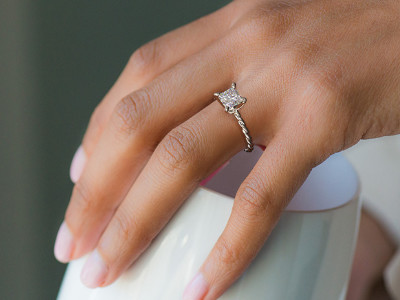
This is the question most buyers are quietly asking but don’t always say out loud. The honest answer: it depends on finger size, shape, and setting — and many people are pleasantly surprised.
Average Half Carat Diamond Dimensions
A round brilliant 0.50 ct diamond measures approximately 5.1 mm in diameter. That’s smaller than a 1 ct stone (around 6.5 mm), but on a size 6 finger it reads as elegant and proportional rather than small.
How Shape Changes Visual Size
The shape you choose has a bigger impact on perceived size than you might expect.
Shape
Visual Size at 0.50 ct
Marquise
Largest face-up appearance
Oval
Very large — often looks like a 0.70 ct round
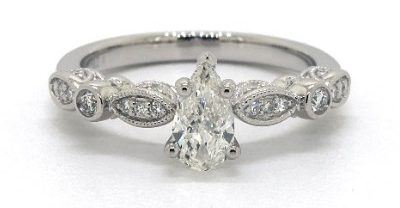
Pear
Large appearance
Princess / Cushion
Close to round
Round Brilliant
Smallest face-up for weight
An oval half carat is a smart move if visual size matters to you. You’ll typically pay 10–20% less than a round of equivalent quality, and the elongated shape creates the illusion of more finger coverage.
How to Make a Half Carat Diamond Look Bigger
Choose an oval, pear, or marquise shape — elongated shapes read larger face-up
Use a thin band — thin bands make any center stone look proportionally larger
Consider a halo setting — the ring of small surrounding diamonds adds perceived size (adds $300–$600)
Opt for white metal — white gold and platinum reflect into the stone, enhancing its brightness
Buy slightly shy — a 0.47–0.49 ct diamond looks identical to a 0.50 ct stone to the naked eye, but bypasses the “magic number” price premium and saves 10–15%
The “Buying Shy” Trick — Save 10–15% Instantly
This is one of the most practical tips you won’t find prominently on retailer sites. Diamond prices jump at round-number thresholds — 0.50 ct, 0.75 ct, 1.00 ct — because demand spikes there.
A 0.48 ct and a 0.50 ct diamond sit side by side and look identical. No one can tell the difference without a scale. But the 0.48 ct stone will cost 10–15% less, simply because it doesn’t hit the psychological threshold.
The option I’d choose: a 0.47–0.49 ct oval in G/VS2 with Excellent cut. You get the visual size of a half carat (or larger, with the oval), you skip the weight premium, and you can put the savings toward a better setting.
Half Carat Diamond Ring Value: Is It a Good Buy?
The 0.50 ct is one of the better value sizes in diamond shopping, for a few reasons.
First, you avoid the severe price premium of the 1.00 ct threshold. Second, the half carat range still gets you a diamond large enough to feature prominently in most settings. Third, at this size, you have more budget flexibility for cut quality — which is where the real difference between a mediocre and a beautiful diamond lives.
The Sweet Spot Most Buyers Should Target
Color: G or H — visually white, not overpriced
Clarity: VS2 or SI1 — eye-clean without paying for microscope-level perfection
Cut: Excellent or Ideal — non-negotiable; this is what makes a diamond sparkle
One common mistake: buyers spend extra on D–F color or FL–VVS clarity, believing it makes the diamond better-looking. It rarely does. A well-cut H/SI1 diamond outsparkles a poorly cut D/FL every time. The cut quality is where your budget should go.
Half Carat Round Diamond Ring Price
Round brilliants are the most popular shape — and the most expensive. They carry a premium for two reasons: they require cutting away more rough material, and demand is highest for rounds.
Round vs Other Shape Price Comparison
Shape
Typical Price vs Round Brilliant
Round
Baseline
Oval
10–20% lower
Pear
10–20% lower
Cushion
10–15% lower
Princess
5–10% lower
Is the round premium worth it? For buyers who love classic brilliance, yes. The round cut was engineered for maximum light return and it delivers. But a well-cut oval at a 15% discount often looks larger and equally brilliant — making it a strong challenger.
Factors That Affect Half Carat Diamond Ring Prices
Cut Quality
The most important factor, and the one most buyers underweight. Cut determines how a diamond interacts with light — its brightness, fire, and sparkle. Never drop below Excellent or Very Good.
Color Grade
Moving from D to G saves roughly 15–25% with no visible difference. The sweet spot is G–H. Below J, a slight yellow tint becomes visible in white metal settings.
Clarity Grade
At 0.50 ct, VS2 and SI1 are typically eye-clean. Moving up to VVS2 or FL adds cost without adding visible quality. Save your budget here.
Ring Setting
A simple solitaire adds $250–$450. A halo adds $400–$700. Custom or designer settings can add several thousand. The setting is where your taste and budget intersect.
Metal Choice
14K gold offers durability at a lower price. 18K adds gold content and a richer color. Platinum is the most durable and hypoallergenic, but the heaviest and most expensive.
Brand Markup
The same quality half carat diamond from Tiffany & Co. costs 2–3x what an equivalent stone costs at James Allen or Blue Nile. You’re paying for the blue box and the name. If that matters to you, factor it in — but go in with eyes open.
Where to Buy a Half Carat Diamond Ring
Best for Natural Diamonds
James Allen — The 360° HD viewer is genuinely useful for evaluating a stone before buying. GIA-certified diamonds, strong inventory depth at the 0.50 ct range, and competitive pricing. A smarter use of your budget than walking into a mall store.
Blue Nile — Large inventory, competitive natural diamond pricing, and a clean interface for comparing stones side by side. Slightly less visual detail in the viewer than James Allen, but reliable.
Best for Lab-Grown Diamonds
James Allen — The same viewing tools apply here, and their lab-grown selection at the 0.50 ct range is extensive. You can filter by cut grade, find Excellent-cut stones under $500 easily, and build the ring in the same workflow.
Brilliant Earth — Known for ethical sourcing and premium lab-grown options. Prices run slightly higher than James Allen, but the setting designs are distinctive. Worth it if aesthetics and sourcing credentials matter to you.
Best for Custom Rings
If you want a non-standard setting or a more bespoke experience, both James Allen and Brilliant Earth offer design consultation. James Allen’s custom process is particularly smooth for buyers who want something slightly different without full custom pricing.
Common Mistakes to Avoid
Paying for D–Flawless grades. At 0.50 ct, the jump in price from H/VS2 to D/FL is significant. The visual difference in person is essentially zero.
Ignoring cut quality. This is the biggest mistake in diamond buying, full stop. A mediocre cut on a technically high-grade diamond produces a dull stone. Always prioritize cut first.
Going straight to a designer brand. You can get an identical diamond to a Tiffany stone for significantly less through an online retailer. The brand markup is real and substantial at this price point.
Choosing the wrong setting for the shape. Elongated shapes like oval and pear need proper prong placement to protect the pointed ends. Make sure any setting you choose is designed for the shape you’ve chosen.
Overlooking resale value if you’re lab-grown curious. It’s not a dealbreaker, but worth knowing before you buy.
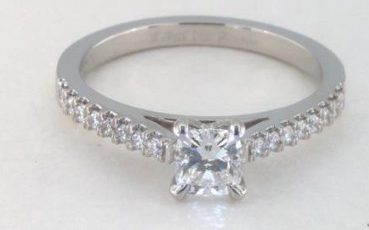
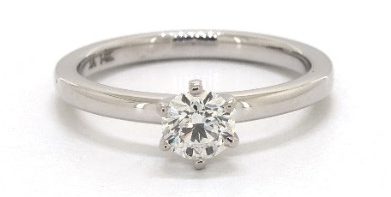
0.50 Carat F-VVS2 Good Cut Round Diamond 2mm Comfort Fit Solitaire Engagement Ring (Six Prong)
Final Verdict: How Much Should You Spend?
For most buyers, the sweet spot for a half carat diamond ring is $1,200–$2,500. That range buys a genuinely beautiful ring — Excellent cut, G–H color, VS2 or SI1 clarity — whether you go lab-grown or natural.
If maximizing visual quality per dollar is the goal, a lab-grown half carat diamond ring is the clear winner. You’ll get a larger, better-specified stone for the same money. The only real sacrifice is origin story and resale value.
If long-term ownership, heirloom potential, and the traditional diamond narrative matter, a natural half carat remains a solid choice. Just make sure you’re prioritizing cut over color or clarity grades you won’t see with the naked eye.
The recommendation for most readers: start with James Allen’s lab-grown inventory in the 0.47–0.50 ct oval or round range, filter for Excellent cut, G color, VS2 clarity, and browse the 14K white gold solitaire settings. You’ll likely find something beautiful for under $1,500 — and you’ll know exactly why it’s a good buy.
Frequently Asked Questions
How much is a 1/2 carat diamond ring worth?
A half carat diamond ring is worth $700–$4,500+ depending on whether the diamond is lab-grown or natural, cut quality, and the setting. Lab-grown rings at this size typically retail for $700–$2,000. Natural diamond rings run $1,500–$5,000+. Designer brands (Tiffany, Cartier) sit at the high end regardless of diamond origin.
What is the average half carat engagement ring price?
Most buyers spend $1,200–$3,500 on a half carat engagement ring in 2026. The average skews upward for natural diamonds and downward for lab-grown. A well-specified lab-grown ring with Excellent cut can land under $1,500.
Is a half carat diamond too small for an engagement ring?
No. A 0.50 ct round diamond measures around 5.1 mm — proportional on most finger sizes, and elegant rather than modest. Elongated shapes like oval or pear will read even larger. Many people find half carat diamonds more wearable than larger stones for daily life.
How much does a half carat natural diamond ring cost?
A 0.50 ct natural diamond in G/VS2 with Excellent cut costs roughly $1,200–$2,500 for the diamond alone, plus $250–$900 for a setting depending on metal. Total ring price typically runs $1,500–$4,000 from reputable online retailers.
How much does a half carat lab-grown diamond ring cost?
A lab-grown 0.50 ct diamond in G/VS2 with Excellent cut runs approximately $400–$700 loose. Add a 14K gold solitaire setting and you’re looking at $700–$1,500 for a complete ring.
Is a half carat solitaire diamond ring a good choice?
Yes — a solitaire is often the smartest choice at this size. The clean design puts all focus on the diamond, keeps setting costs down, and ages better than trend-driven styles. It’s the most timeless option in this price range.
Does a half carat round diamond cost more than other shapes?
Yes. Round brilliants carry a 10–20% premium over fancy shapes like oval or pear due to higher rough diamond waste and peak demand. An oval half carat delivers comparable or larger face-up appearance for less money.
What’s the best quality grade for a half carat diamond ring?
G–H color, VS2–SI1 clarity, Excellent or Ideal cut. This combination gives you a visually excellent stone without paying for grading distinctions you won’t see in real life. Cut quality is the priority — never compromise there.
Affiliate disclosure: TwirlWeddings earns a commission from qualifying purchases made through links on this page. This never affects our recommendations. …