

Last updated: 2026 — Affiliate disclosure: TwirlWeddings is reader-supported. If you buy through links on this page, we may earn a commission at no extra cost to you. This doesn’t affect our opinions — we’d tell you to skip a bad retailer even if they paid us double.
If you’ve started shopping for an engagement ring online, you’ve almost certainly landed on Blue Nile’s site at some point. It’s one of the oldest names in online diamond retail, and “Blue Nile review” is one of the most-searched terms by people trying to figure out whether they should actually trust a company with a $5,000–$15,000 purchase.

Short answer: yes, for most natural diamond shoppers, Blue Nile is legit, well-run, and a smart place to start. But there are a few things that have changed about Blue Nile recently — especially around lab-grown diamonds — that could matter a lot depending on what you’re shopping for. We’ll get into all of it.
Quick Verdict
Overall rating: 4.4 / 5
- Best for: Natural diamond engagement rings, especially for buyers who want a huge GIA-certified inventory and a polished, premium online experience
- Biggest strengths: Massive natural diamond selection, competitive pricing relative to physical jewelers, strong GIA certification standards, solid return policy
- Biggest weaknesses: Lab-grown diamond selection has shrunk significantly, customer service can be hit-or-miss depending on when you contact them, fewer physical locations than some competitors
- Who should buy from Blue Nile: Buyers focused on natural diamonds who are comfortable shopping online and want a wide selection at fair prices
- Who should consider alternatives: Buyers whose top priority is lab-grown diamonds, or buyers who want an in-person, design-led experience
Pros and Cons
Pros
- Enormous natural diamond inventory with detailed filtering
- GIA-certified diamonds as the standard, not the exception
- Pricing that consistently beats traditional jewelry stores
- Strong build-your-own-ring tools for engagement rings and wedding bands
- Established company with decades of operating history and a recognizable name
Cons
- Blue Nile has pulled back hard on lab-grown diamonds, which is a letdown if that’s what you came for
- Customer service quality varies — some buyers get fast, expert help, others wait longer than they’d like
- Only a couple dozen physical showroom locations, so most buyers are shopping sight-unseen
- The “virtual inventory” model means a diamond you’re eyeing can sell out from under you before you finish checkout
If you’re trying to decide between Blue Nile and a more design-forward competitor, our James Allen vs. Blue Nile comparison and Brilliant Earth vs. Blue Nile breakdown go deeper on how they stack up side by side.
What Is Blue Nile, and What Changed in 2026?
Blue Nile launched in the late 1990s as one of the first companies to sell diamonds online, at a time when “buying a $6,000 diamond ring from a website” sounded borderline reckless to most people. It worked because Blue Nile did something traditional jewelers wouldn’t: it showed exact specs, GIA certificates, and prices for every stone, instead of hiding behind “ask our associate.”
Blue Nile is owned by Signet Jewelers, the same parent company behind Kay Jewelers, Zales, and James Allen. That ownership structure matters more than it used to, because in the last couple of years Signet has been deliberately repositioning its brands so they don’t compete with each other for the same customer.
Here’s the practical effect of that repositioning:
- Blue Nile is now Signet’s natural-diamond flagship. The site is leaning hard into being the place for high-quality, certified natural diamonds, particularly for buyers spending more — Signet has been pushing average order values toward the $10,000+ range.
- James Allen has become Signet’s lab-grown and tech-forward storefront. If your priority is lab-grown center stones with the famous 360° viewer experience, James Allen (now folded into the Blue Nile/Signet ecosystem after the brands merged operations) is where that inventory mostly lives now.
- Signet also acquired The Clear Cut, a luxury natural-diamond retailer known for white-glove, gemologist-led shopping. Pieces of that experience — more personalized guidance, higher-end stone curation — have been folded into how Blue Nile presents its natural diamond selection.
What does this mean if you’re shopping right now? If you want a natural diamond, Blue Nile is arguably in a stronger position than ever — the site is more focused, the natural diamond inventory is deep, and the buying experience feels more premium than it did a few years ago. If you specifically want a lab-grown center stone, Blue Nile’s grids for that have noticeably thinned out, and you’ll likely find a better selection elsewhere. We cover this trade-off in detail in our guide to where to buy lab-grown diamonds online.
How Blue Nile Works
Blue Nile’s site is organized around four main categories:
- Loose diamonds — search and filter thousands of individually certified stones
- Engagement rings — pre-set rings, or “build your own” starting from a setting or a diamond
- Wedding bands — for both halves of the couple
- Fine jewelry — earrings, necklaces, bracelets, and gemstone pieces
The core workflow most people use is the build-your-own-ring tool: you either pick a setting first and then shop diamonds that fit it, or pick a diamond first and then browse settings that work with it. It’s a simple system, but it’s effective — and it’s one of the things Blue Nile has done well for years.
Is Blue Nile Legit?
This is the question most people actually want answered before they read another word, so let’s be direct: yes, Blue Nile is a legitimate, established company, not a scam, drop-shipper, or fly-by-night operation.
A few reasons that confidence is warranted:
- Decades in business. Blue Nile has been selling diamonds online since 1999 — longer than most of its competitors have existed.
- Public company heritage and Signet ownership. Being part of Signet Jewelers (one of the largest jewelry retailers in the world) means Blue Nile operates under real corporate oversight, not as an anonymous storefront.
- GIA certification as standard practice. Every diamond listed comes with grading documentation from a recognized lab, almost always GIA.
- Secure payment processing and buyer protections. Standard encryption, fraud monitoring, and credit card protections apply the same way they would with any major online retailer.
- Real return and warranty policies that are enforced, not just listed for show — we cover the specifics in our Blue Nile return policy and warranty review.

If you want the long-form breakdown — including how Blue Nile compares on trust signals to other online jewelers — our dedicated Is Blue Nile Legit or a Scam? article covers it in more depth.
So Why Do Some People Search “Is Blue Nile a Scam”?
Mostly because spending five figures on something you can’t hold before you buy feels uncomfortable, and that discomfort gets typed into Google. The actual complaints that show up online tend to fall into a few buckets: shipping delays during high-demand periods, customer service response times that didn’t match expectations, and the occasional mismatch between how a diamond looked online versus in person (which, to be fair, is a risk with any online diamond purchase, not just Blue Nile’s).
None of that adds up to “scam.” It adds up to “online retailer with normal online retailer issues, at a scale where even a small percentage of unhappy customers generates a lot of forum posts.”
Blue Nile Diamond Quality Review
This is the section that actually matters most if you’re spending real money, so let’s slow down here.
Where Do Blue Nile’s Diamonds Come From?
Blue Nile operates largely on a virtual inventory model. For most of its loose diamond catalog, Blue Nile doesn’t physically hold every stone in a warehouse — instead, it has agreements with diamond cutters and suppliers around the world (heavily concentrated in major cutting centers) and lists their inventory in real time.
Here’s why that’s actually good for you as a buyer: it means Blue Nile can offer a far larger selection than a company that only sells what’s sitting in its own vault, and it’s part of why prices tend to run lower than a traditional jeweler with the overhead of physical inventory.
Here’s the catch: because the inventory is shared across multiple retail sites, a specific diamond you’ve fallen in love with can occasionally be purchased through a different retailer before you complete your own checkout. It doesn’t happen often, but if you’re set on one exact stone, don’t leave it in your cart for a week while you “think about it.”
Are Blue Nile Diamonds Certified?
Yes — and this is one of Blue Nile’s genuine strengths. The overwhelming majority of diamonds sold through Blue Nile come with GIA certification. GIA is widely considered the gold standard for diamond grading, and Blue Nile has built its reputation around sticking to it rather than relying on looser in-house or lesser-known labs.
You may occasionally see references to AGS (American Gem Society) certification in older reviews — AGS was historically known for an extremely strict “Ideal” cut grading system. AGS has since fully merged its grading operations into GIA, so you won’t find new AGS-graded stones; GIA has effectively absorbed that standard. If you want a refresher on how the major labs compare, our guide to which diamond certification is best is a good companion read, as is our deeper dive on GIA certification costs and standards.
How Strict Are Blue Nile’s Quality Standards?
Blue Nile’s filtering tools let you search by cut grade, and the site does carry diamonds across the full spectrum from “Good” up through “Ideal” cuts. The good news is the filtering is genuinely useful — you can isolate Very Good and Ideal cut grades easily.
The thing to watch for: Blue Nile’s massive inventory means there are also plenty of lower-tier stones mixed in, and the photos/videos for some listings are more limited than what you’d get on a site built entirely around 360° imaging (which, not coincidentally, is more of a James Allen specialty within the Signet family now).
Our practical assessment:
- Excellent value diamonds: Stones in the G–I color range, VS1–VS2 clarity, with a Very Good or Ideal cut. These are where Blue Nile’s pricing tends to shine — you get a stone that looks essentially flawless to the naked eye without paying for grades only a jeweler’s loupe would notice. Our diamond color meaning guide and diamond clarity explained article break down exactly why this combination works so well.
- Average diamonds: Lower color grades (J–K) paired with lower clarity (SI1–SI2) — fine for a budget-focused buyer who understands what they’re getting, less ideal if you’re chasing maximum sparkle.
- Diamonds to avoid (or at least scrutinize closely): Stones with a “Good” or “Fair” cut grade combined with strong fluorescence and limited imaging. A poorly cut diamond will look dull regardless of how good its color and clarity numbers are on paper — cut is the one C that has the biggest visual impact, which we explain in our diamond cut meaning guide. If you’re chasing maximum light performance, it’s worth understanding what a super ideal cut diamond actually means before you filter your search.
The recommendation for most readers: don’t just filter by the 4Cs in isolation. A VS2/G/Ideal cut diamond will often look better and cost less than a VVS1/D/Good cut diamond. The sweet spot is prioritizing cut first, then clarity and color second.
Blue Nile Engagement Rings Review
Ring Settings Quality
Blue Nile’s settings are manufactured to reasonably consistent standards — prong work, metal purity stamping, and finishing are all what you’d expect from a major retailer. The metal options cover the bases: platinum, 14K and 18K white gold, yellow gold, and rose gold.
Popular Engagement Ring Styles
Blue Nile’s catalog spans the styles most engagement ring shoppers are looking for:
- Solitaire — the classic, and still Blue Nile’s bread and butter; clean lines that let a well-cut diamond do the talking
- Halo — a center stone surrounded by a ring of smaller diamonds, which makes the center stone look larger (a smart move if you’re trying to maximize visual size on a budget)
- Pavé — small diamonds set along the band for extra sparkle without a big jump in price
- Three-stone — symbolic settings, often chosen for sentimental reasons
- Vintage-inspired — milgrain detailing, filigree, and antique-style profiles
If you’re still deciding on a setting style and want the full picture before you start customizing, our guide to 21 engagement ring setting types is worth reading first — it’ll help you walk into Blue Nile’s build-your-own tool already knowing what you want.
Can You Customize a Ring?
Yes, and this is genuinely one of Blue Nile’s stronger features. The build-your-own-ring system lets you choose a setting, then filter diamonds that are compatible with it by shape, size, and budget — or start from a diamond and find settings that suit it. With the influence of The Clear Cut integration, Blue Nile has also been emphasizing more curated, expert-guided selection for higher-end purchases, which is a noticeable step up from the “browse and hope” feel some discount sites have.
How Blue Nile Compares on Ring Design
Compared to a brand like Whiteflash — which leans heavily into “super ideal” cut precision and a more boutique, hands-on feel — Blue Nile’s strength is breadth and value rather than ultra-niche specialization. If your priority is the absolute tightest cut precision available and a more concierge-style experience, it’s worth comparing the two directly in our Whiteflash vs. Blue Nile guide. For most buyers, though, Blue Nile’s selection and pricing hit the sweet spot without needing to go that niche.
Blue Nile Wedding Bands Review
Wedding bands are an easy win for Blue Nile, mostly because they’re a simpler product than an engagement ring — fewer variables, lower price points, and less risk if something doesn’t match your expectations exactly.
Women’s Wedding Bands
Options range from simple metal bands to diamond-set eternity and half-eternity styles designed to sit flush against an engagement ring. If you’re planning to stack your wedding band with your engagement ring, it’s worth thinking through how the profiles will sit together — our guide on how to stack rings covers the practical side of that.
Men’s Wedding Bands
Blue Nile’s men’s band selection covers traditional precious metal bands plus some alternative-metal options. If you’re shopping for someone with an active job or hands-on lifestyle, it’s worth comparing durability — our cobalt chrome wedding bands guide and roundup of wedding bands for working men both go into which metals hold up best.
Material Options
- Platinum — the most durable and hypoallergenic, at a price premium
- White gold — a more affordable look-alike to platinum, though it requires occasional rhodium replating (our rhodium plating guide explains what that involves)
- Yellow gold — classic, lower-maintenance than white gold since it doesn’t need replating
- Rose gold — a warmer-toned, increasingly popular option
If you’re undecided between white gold and platinum specifically, our platinum vs. white gold comparison lays out the cost and maintenance differences clearly.
Blue Nile Jewelry Review
Beyond engagement rings, Blue Nile runs a sizable fine jewelry operation, and this is where the “blue nile jewelry store” search intent comes in.
Diamond Earrings
Studs are Blue Nile’s bread and butter here — and the same GIA-certified sourcing standards apply to loose diamonds used in earrings as in engagement rings. If diamond studs are on your list, our guide on how much diamond earrings cost is a useful pricing baseline before you shop.
Diamond Necklaces
Pendant necklaces, tennis-style diamond necklaces, and solitaire pendants are all well represented. For a broader view of where these tend to be best priced across retailers, see our best places to buy a diamond necklace roundup.
Tennis Bracelets
Blue Nile’s tennis bracelet selection spans a wide range of total carat weights and price points, with the same certification transparency as their rings.
Gemstone Jewelry
Blue Nile also carries colored gemstone pieces — sapphire, emerald, and ruby jewelry in particular. If you’re considering a colored stone instead of (or alongside) diamonds, our gemstones guide is a solid starting point for understanding durability and value across stone types.
Is Blue Nile Jewelry Worth Buying?
For diamond jewelry specifically — yes, the same quality and certification standards that make Blue Nile a solid engagement ring retailer carry over. For colored gemstone jewelry, Blue Nile is competent but not necessarily the specialist; if sapphires or emeralds are your main focus, it’s worth at least comparing against retailers that specialize in colored stones.
Blue Nile Pricing Review
Is Blue Nile Expensive?
Relative to a traditional brick-and-mortar jeweler — no, not even close. Relative to some of the most aggressively discounted online-only competitors — Blue Nile sits somewhere in the middle, leaning toward the “fair value for a premium-feeling experience” end of the spectrum rather than the absolute rock-bottom end.
How Blue Nile Prices Compare to Local Jewelry Stores
Local jewelers carry significant overhead: physical showroom space, in-house staff, smaller inventory turnover, and markups that reflect all of that. Blue Nile’s online model strips most of that out. For an equivalent diamond — same carat, color, clarity, and cut — it’s common to see Blue Nile pricing run noticeably below what a mall jeweler would quote for a comparable stone.
Why Blue Nile Often Costs Less
A few structural reasons:
- The virtual inventory model means lower carrying costs on physical stock
- Higher sales volume allows for better margins at lower per-unit prices
- No commissioned sales staff pushing upgrades on the showroom floor
Blue Nile vs. Traditional Jewelers
The honest framing here: a traditional jeweler can offer something Blue Nile can’t — the ability to physically see and compare stones side by side before buying, and an in-person relationship if something needs fixing later. Blue Nile’s trade-off is that you give up some of that in exchange for a meaningfully larger selection and better pricing. For most buyers comfortable doing research online (which, if you’re reading this, is probably you), that trade-off works in your favor.
Does Blue Nile Offer Good Value for Money?
For natural diamonds in the $3,000–$15,000 range, yes — this is Blue Nile’s sweet spot. One thing to factor into your budget: depending on your state, you may owe sales tax on a Blue Nile purchase. We break down exactly how that works in our Blue Nile sales tax guide, since it can meaningfully change the total cost on a high-ticket item.
It’s also worth checking for active promotions before you check out — Blue Nile runs sales periodically, and our Blue Nile promo code page tracks current offers. Even a modest percentage off a five-figure purchase is real money. And if you’d rather spread the cost out, it’s worth knowing how Blue Nile financing works before you start building your ring — knowing your monthly payment range in advance can help you shop with a clearer budget ceiling instead of getting anchored to the most expensive option on the page.
Blue Nile Reviews From Real Customers
What Customers Love About Blue Nile
The recurring positive themes in customer feedback line up with what we found in our own research:
- Selection. “I could actually compare hundreds of diamonds instead of looking at three options in a glass case” is a common sentiment.
- Pricing. Customers frequently note getting a noticeably larger or higher-quality stone than they could have afforded at a local jeweler.
- Shipping speed. For in-stock items, turnaround tends to be quick, with discreet, insured packaging — a detail that matters a lot for an expensive ring arriving at someone’s home.
- Ring quality on arrival. Most customers report that what arrives matches what was described and pictured.
Common Blue Nile Complaints
The negative themes are worth taking seriously, not dismissing:
- Customer service inconsistency. Some buyers report fast, knowledgeable responses; others describe longer wait times or reps who couldn’t answer detailed gemological questions. We dig into this specifically in our Blue Nile customer service review.
- Delayed orders during peak periods. Custom or build-your-own orders around the holidays and Valentine’s Day can take longer than the standard estimates.
- Return and resizing friction. Most resolve fine, but a vocal minority describe slower-than-expected processing. Our Blue Nile resizing policy guide walks through exactly what’s covered and what isn’t, so you know what to expect going in.
Overall Customer Sentiment
Net positive, with the caveat that experience quality seems to correlate with order complexity and timing. A simple, in-stock purchase placed outside of peak season tends to go smoothly. A complex custom build placed two weeks before a proposal date in December carries more risk — plan accordingly.
Blue Nile Customer Service Review
How Helpful Is Blue Nile Customer Support?
Blue Nile offers phone, live chat, and email support, with diamond and jewelry consultants available to help with questions about specs, sizing, and customization. For most general questions — shipping status, sizing help, basic product questions — support is responsive and adequate.
Where it gets more mixed is with detailed gemological questions (e.g., “how will this specific stone’s fluorescence look in person?”). Some reps can answer that confidently; others will need to escalate or follow up later.
Phone, Chat and Email Support
- Phone tends to be the fastest route for time-sensitive questions
- Live chat is convenient for quick spec or sizing questions while browsing
- Email works fine for non-urgent questions but expect a slower turnaround
Our Assessment of the Customer Experience
Solid, not exceptional. If customer service responsiveness is a top priority for you — say, you anticipate needing a lot of hand-holding through a custom build — it’s worth reading our full Blue Nile customer service review before committing, and comparing it against what James Allen’s customer service experience looks like for a more tech-tool-driven alternative within the same parent company.
Blue Nile Shipping, Returns & Warranty
Shipping Policies
Standard orders typically ship free, with insured, signature-required delivery for high-value items — a sensible default given what’s inside the box.
Return Policy
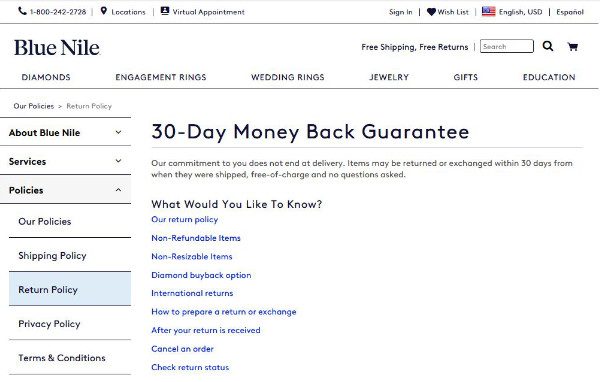
Blue Nile’s return window is generous compared to most physical jewelers, giving you real time to have a diamond independently inspected if you want extra peace of mind. The full terms — including which items are excluded and how refunds are processed — are covered in our Blue Nile return policy and warranty review. One common mistake is assuming everything is returnable; engraved items and certain custom pieces typically aren’t, so check before you customize.
Resizing Services
Free resizing within a limited window after delivery is standard, with some restrictions by ring style and metal type. Our Blue Nile resizing guide has the specifics, including how the process works if your size estimate turns out to be off.
Warranty Coverage
Blue Nile backs its jewelry with a limited lifetime warranty covering manufacturing defects, plus optional extended protection plans for things like accidental damage. If you’re trying to decide whether to add coverage, it’s worth comparing against jewelry insurance options more broadly — our Blue Nile insurance guide breaks down what’s included by default versus what you’d need to add separately.
Trade-In and Upgrade Programs
Blue Nile offers a diamond upgrade program in certain circumstances, allowing you to trade up to a larger or higher-quality stone down the line. The terms are worth reading carefully — these programs are often more limited than they sound in marketing copy, typically requiring you to spend significantly more on the upgrade.
Blue Nile Showrooms & Physical Locations
Does Blue Nile Have Physical Stores?
Yes, but the network is modest — a couple of dozen showroom locations across major U.S. metro areas, not a presence in most towns.
Can You View Rings Before Buying?
If you’re near one of Blue Nile’s showrooms, yes — you can view settings and sometimes specific diamonds in person before purchasing online. For most shoppers without a nearby location, the experience remains primarily online, supported by detailed imaging and certification.
Blue Nile Showroom Experience
The showrooms function more as an appointment-based complement to the online catalog than as a full retail replacement — useful for trying on settings and getting a feel for sizing, less useful as a place to browse the full inventory in person. If a hands-on experience matters most to you, it’s worth weighing this against a competitor with a larger physical footprint, like Brilliant Earth’s 40+ showroom network — though as we’ll get to, that comes with its own trade-offs.
Blue Nile vs. Competitors
Blue Nile vs. James Allen
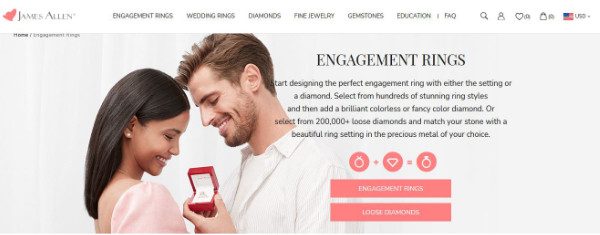
Since both brands are part of Signet Jewelers, this comparison has changed meaningfully. James Allen has become Signet’s primary playground for lab-grown diamonds and the famous 360° interactive viewer technology. Blue Nile has positioned itself as the premium, natural-diamond-first storefront, with a more curated feel influenced by the Clear Cut acquisition.
Practical takeaway: if a lab-grown center stone is non-negotiable for you, James Allen’s grids will likely serve you better right now. If you’re set on a natural diamond and want a slightly more premium browsing experience, Blue Nile has the edge. Our full James Allen vs. Blue Nile comparison goes through this pairing category by category.
Blue Nile vs. Brilliant Earth
Brilliant Earth’s whole brand identity is built around ethical sourcing and sustainability messaging, and it backs that up with a much larger physical showroom network — over 40 locations compared to Blue Nile’s roughly two dozen. If an in-person, design-consultation-heavy experience and sustainability branding are priorities, Brilliant Earth pulls ahead on those specific fronts.

On pricing and raw inventory size, Blue Nile typically remains the stronger value play, particularly for natural diamonds where Brilliant Earth’s pricing tends to run higher for comparable specs. See our Brilliant Earth vs. Blue Nile comparison and our standalone Brilliant Earth review for more.
Blue Nile vs. Clean Origin
Clean Origin is built almost entirely around lab-grown diamonds, at prices that are typically lower than Blue Nile’s lab-grown offerings (where they still exist) and dramatically lower than natural diamond pricing in general.
If your priority is lab-grown and budget is the deciding factor, Clean Origin is worth a serious look — our Clean Origin vs. Blue Nile comparison and Clean Origin review cover this in detail. If natural diamonds are the priority, this comparison tilts firmly back toward Blue Nile.
A Quick Word on Whiteflash
If precision-cut natural diamonds are your top priority — the kind of “super ideal” cut that maximizes light performance — Whiteflash specializes in exactly that niche, with a more boutique feel than Blue Nile’s broader marketplace approach. It’s a smaller selection, but a more curated one. Our Whiteflash vs. Blue Nile comparison and full Whiteflash review lay out where each one wins. For buyers who want that extra layer of cut-quality assurance without giving up online convenience, browsing Whiteflash’s collection is worth a few minutes.
Which Alternative Is Best?
- Want the biggest natural diamond selection at fair prices, with a polished online experience? Stick with Blue Nile.
- Want lab-grown specifically? Look at James Allen or Clean Origin first.
- Want in-person showroom support and sustainability branding? Brilliant Earth.
- Want maximum cut precision and a more boutique feel? Whiteflash.
- Want a traditional mall-jeweler experience with in-person service? Kay Jewelers is worth a look, and our Kay Jewelers review covers what that experience is actually like.
Who Should Buy From Blue Nile?
Blue Nile Is Best For
- Budget-conscious buyers who want a high-quality natural diamond without paying mall-jeweler markups
- Buyers who want a large diamond selection and the ability to compare hundreds of GIA-certified stones side by side
- Online shoppers who are comfortable doing research, reading certificates, and don’t need to physically hold a ring before buying
Blue Nile May Not Be Best For
- Buyers wanting extensive in-store support — Blue Nile’s physical footprint is limited, so most of your experience will be online
- Buyers prioritizing ethical branding above all else — Brilliant Earth leans harder into this messaging if that’s your primary filter
- Buyers seeking a lab-grown center stone specifically — Blue Nile’s selection here has narrowed; James Allen or Clean Origin will likely serve you better
If you’re not sure where Blue Nile fits among online retailers generally, our broader best online diamond stores roundup and best place to buy diamond engagement rings guide put it in context against the full field.
Frequently Asked Questions
Is Blue Nile Legit?
Yes. Blue Nile has been operating since 1999, is owned by Signet Jewelers (one of the largest jewelry retailers in the world), and sells diamonds with GIA certification as standard. It’s a legitimate, established retailer — not a scam.
Are Blue Nile Diamonds Real?
Yes. Blue Nile sells genuine natural diamonds (and some lab-grown diamonds, though that selection has narrowed), all with verifiable certification from recognized grading labs, primarily GIA.
Is Blue Nile Better Than James Allen?
It depends on what you’re buying. For natural diamonds and a more curated, premium feel, Blue Nile currently has the edge. For lab-grown diamonds and 360° interactive viewing technology, James Allen is generally the stronger option. Both are part of Signet Jewelers, so neither is a “wrong” choice — it comes down to which inventory matches your priorities.
Does Blue Nile Sell Lab-Grown Diamonds?
Yes, but the selection has shrunk noticeably as Blue Nile has repositioned toward natural diamonds. If a lab-grown center stone is your priority, you’ll likely find a deeper selection through James Allen or a lab-grown specialist like Clean Origin.
Can You Return a Blue Nile Ring?
Yes, Blue Nile offers a return window that’s generous compared to most physical jewelers, though some custom and engraved items are excluded. Full details are in our Blue Nile return policy guide.
Does Blue Nile Have Physical Stores?
Yes, but the network is limited to roughly two dozen showroom locations in major U.S. cities. Most buyers will shop primarily online.
Is Blue Nile Good for Engagement Rings?
Yes, particularly for natural diamond engagement rings. The combination of GIA certification, large selection, build-your-own tools, and competitive pricing makes it one of the stronger options for this specific purchase.
Is Blue Nile Worth It?
For most natural diamond shoppers — yes. You get a wider selection and better pricing than a traditional jeweler, backed by real certification and a workable return policy. If lab-grown diamonds are your focus, weigh Blue Nile against James Allen or Clean Origin before deciding.
Final Verdict: Is Blue Nile Worth Buying From in 2026?
Our Overall Rating
| Category | Rating |
|---|---|
| Diamond Quality | 4.5 / 5 |
| Ring Quality | 4.3 / 5 |
| Pricing | 4.5 / 5 |
| Customer Service | 3.8 / 5 |
| Policies | 4.3 / 5 |
| Overall Value | 4.4 / 5 |
The Bottom Line
For most readers shopping for a natural diamond engagement ring or wedding jewelry, Blue Nile is a buy-with-confidence retailer. The combination of a huge GIA-certified inventory, pricing that consistently beats traditional jewelers, and a return policy that gives you real room to change your mind makes it one of the more reliable places to spend a significant amount of money online.
The one group that should pump the brakes: if a lab-grown center stone is the whole point of your search, Blue Nile’s narrowed selection means you’re better served starting elsewhere — even if that “elsewhere” is technically another Signet-owned brand.
For everyone else — if you want to see what Blue Nile actually has in your size and budget range, browse Blue Nile’s current diamond inventory here and filter by cut grade first, then color and clarity, to land on the sweet spot most buyers should be targeting. If you want a second opinion on pricing for the exact same specs, it only takes a few minutes to compare against Whiteflash’s selection — and if you’d rather see and try on rings in person before deciding, a Kay Jewelers location near you is worth a visit.
Whichever direction you go, the diamond itself is the part of this purchase that’s permanent — getting the cut, clarity, and color combination right matters more than which retailer’s logo is on the box.